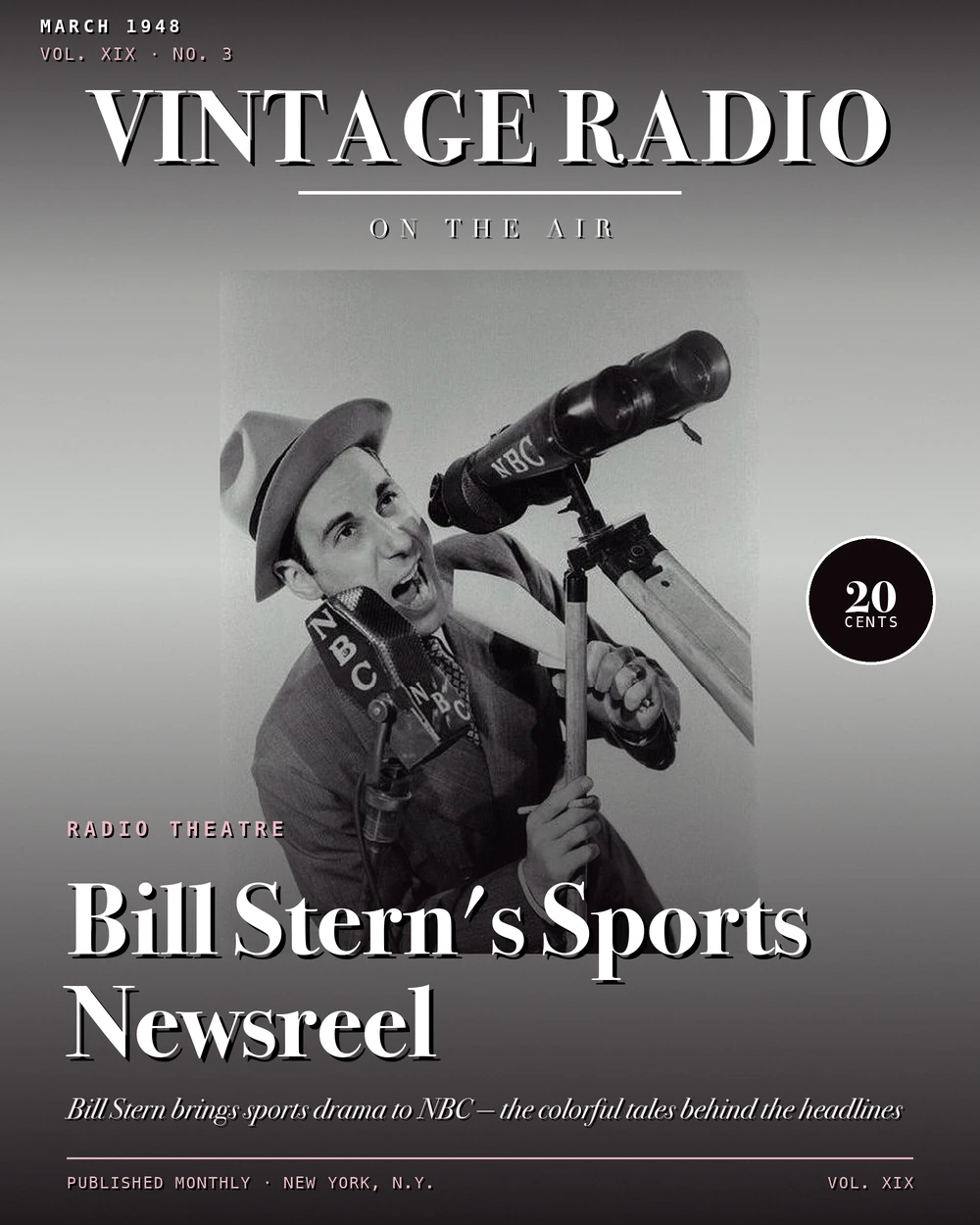
Bill Stern's Sports Newsreel
The Man Behind the Microphone
Bill Stern was not a conventional sports announcer, and his program was not a conventional sports broadcast. Born July 1, 1907, in Rochester, New York, he got his start in radio in 1925 at WHAM, calling football games. Before he ever settled into a broadcast booth full time, he served as the first stage director of Radio City Music Hall when it opened in 1932 — an experience that sharpened his instinct for theatrical pacing and dramatic presentation. Those instincts would define everything he did on air for the next three decades.
In 1935, Stern was in a serious car accident that resulted in the amputation of one of his legs. He became addicted to painkillers during his recovery, a struggle he later addressed candidly in his 1959 autobiography The Taste of Ashes, written with Oscar Fraley. NBC hired him in 1937, and he began a sustaining show known as Bill Stern's Sports Review. The Colgate-sponsored version — The Colgate Shave Cream Sports Newsreel, the title most listeners came to know — premiered on NBC Blue in October 1939, with Colgate's sponsorship beginning formally on October 8 of that year.
From 1940 through 1952, thirteen consecutive years, Stern was named the top sportscaster in the Radio Daily Magazine poll of U.S. radio editors. NBC appointed him its Director of Sports on April 15, 1941, a post he held through 1952. Whatever the competition thought of his methods, his audience kept coming back.
What the Show Actually Was
Each episode ran fifteen minutes — a quarter-hour format built around dramatized sports stories, organ music, and sound effects. A male quartet opened the program with a signature theme that introduced Stern as "the Colgate shave-cream man." Stern himself would launch individual segments with the recurring phrase "Portrait of an athlete!" or "Portrait of a man!" before launching into a story. The structure was brisk and theatrical, shaped by Stern's fast-talking vaudevillian delivery, strategic pauses, and a precise sense of when to punch a particular word for maximum effect.
Stern described the show's design as stories "with an O. Henry twist; stories set to music, and fableized and dramatized for appeal to the housewife as well as the sports-hungry husband." That phrase — "fableized" — turned out to be more accurate than audiences might have realized. A significant portion of the content presented as fact on the Newsreel was actually fiction, constructed by Stern's writers at his direction. After one particularly notable fabrication involving Abraham Lincoln and baseball, NBC stepped in and required Stern to label his stories "sports legends," with a disclaimer that they "might be actual, may be mythical, but definitely interesting." It was an unusual arrangement — a sports program that openly acknowledged it might be making things up — but it fit the show's personality exactly.
The storytelling structure Stern pioneered has been cited as a direct forerunner of Paul Harvey's "The Rest of the Story," which adopted a remarkably similar narrative shape decades later.
A Guest List That Ranged Across Everything
Part of what kept the Newsreel from being just a sports broadcast was Stern's habit of mixing athletes with entertainers from entirely different worlds. The show welcomed Lou Gehrig, Connie Mack, Jack Dempsey, Jesse Owens, and Casey Stengel on the sports side — and Frank Sinatra, Lena Horne, Henny Youngman, George Raft, Hoagy Carmichael, and Xavier Cugat on the entertainment side. Madeline Carroll, Canada Lee, Tony Martin, and Vivian Blaine also appeared. On January 2, 1948, the guest was a former sportscaster and future U.S. President: Ronald Reagan.
That mix was deliberate. The show was designed to reach an audience broader than the sports-obsessed listener, and Stern's theatrical sensibility made celebrity guests feel natural rather than awkward. The Newsreel was described as "one of the most successful and most listened-to shows in radio history" and "one of radio broadcasting's most entertaining and engaging programs" — assessments that reflected its genuine cross-demographic reach during peak years.
During World War II, NBC rebroadcast the Newsreel by transcription to members of the U.S. armed forces stationed abroad, which extended its reach considerably beyond its domestic audience.
The Controversies
Stern's career wasn't without friction, and some of it came from his own doing. On September 15, 1944, he reported that a Chicago newspaper had broken word of an alleged arrangement for the St. Louis Browns to lose their only World Series. The story landed badly, and Stern later apologized and expressed regret for reporting it. The episode illustrated the risk that came with his freewheeling approach to sourcing — the same instinct that made the Newsreel entertaining made it occasionally irresponsible.
He also waded into the long-running argument over who invented the curveball. In 1949, Stern publicly sided with Fred Goldsmith over the more commonly credited Candy Cummings, championing Goldsmith's case in his book Bill Stern's Favorite Baseball Stories. It was a minority position in a debate that had been simmering for decades and remains unresolved.
Throughout his career, Stern maintained what contemporaries described as a fierce rivalry with CBS sportscaster Ted Husing, with the two competing aggressively for broadcast position and rights to major events. Both were eventually inducted into the American Sportscasters Association Hall of Fame as part of its inaugural 1984 class — alongside Red Barber, Don Dunphy, and Graham McNamee.
The Broadcast Firsts
Whatever the controversies, Stern's place in the technical history of American broadcasting is well documented. He is credited as being among the first to do live remotes of sporting events. More specifically, on May 17, 1939, he called the first televised baseball game in history — the second game of a Princeton-Columbia doubleheader at Columbia's Baker Field, broadcast on NBC's experimental station W2XBS. Princeton won 2–1 in ten innings. The game was a college contest, not a Major League Baseball game; the first MLB telecast came later that year, on August 26, 1939, with Red Barber announcing. Stern also called the first televised football game on September 30, 1939.
Beyond radio and early television, Stern served as the sports voice for MGM's News of the Day newsreels for roughly fifteen years and narrated Columbia Pictures' Bill Stern's World of Sports short subjects. He appeared in several films playing himself, including The Pride of the Yankees (1942), We've Never Been Licked (1943), Stage Door Canteen (1943), Here Come the Co-Eds (1945), and The West Point Story (1950). The character "Bill Kern" in Woody Allen's Radio Days was modeled directly on Stern's storytelling style — a measure of how recognizable that style remained long after the show itself was off the air.
The End of the Run and What Came After
The catalog of known episodes runs from September 12, 1942, through October 13, 1950, with 122 episodes documented. Colgate dropped its sponsorship in June 1951, with the final Colgate broadcast airing on June 29 of that year. The show continued on NBC as Bill Stern's Sports Newsreel through September 1953, then moved to ABC, where it ran until June 1956. After leaving ABC, Stern returned to sports broadcasting as sports director of the Mutual Broadcasting System, a role he held through the 1960s.
He was elected to the National Sportscasters and Sportswriters Hall of Fame in 1974 and was posthumously inducted into the National Radio Hall of Fame in 1988. He has a star on the Hollywood Walk of Fame. Stern died November 19, 1971, of a heart attack at his home in Rye, New York. The Taste of Ashes, his autobiography, remains one of the more candid self-portraits any broadcaster of his era left behind — an account of genuine success, genuine excess, and the cost of both.